1. WAVES
Wave Motion
A wave is the motion of a disturbance
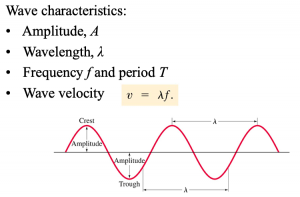
Wavelength: the distance between successive crests.
Frequency: number of crests that pass a given point per unit time.
Amplitude: maximum height of crest.
Wave velocity: v = λf
The frequency of a wave depends only on the source producing the wave. It will therefore not change if the wave enters a different medium or the properties of the medium change
The Speed of waves only depends on the nature and the properties of the medium
- Water waves do travel faster in deeper water
- Light travels slower in more optically dense material
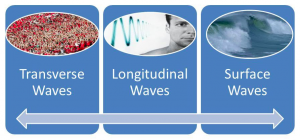
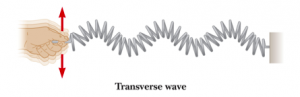
Types of Waves – Transverse
- In a transverse wave, each element that is disturbing moves in a direction perpendicular to the wave motion
Types of Waves – Longitudinal
- In a longitudinal wave, the elements of the medium undergo displacements parallel to the motion of the wave
- A longitudinal wave is also called a compression wave
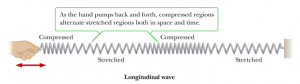
Types of Waves – Transverse and Longitudinal
Surface waves shows the characteristics of both transverse and longitudinal waves.
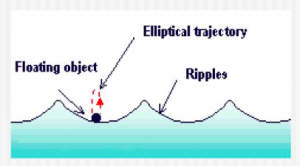
Mechanical waves
–Require some source of disturbance- a medium that can be disturbed
–Some physical connection or mechanism through which adjacent portions of the medium influence each other
Electromagnetic waves
-all travel at the speed of light in a vacuum (300000000 m/s)
-all can travel in a vacuum
- All waves carry energy and momentum