1. Position and Displacement
Distance:
It is defined as the total path length taken between two points. It is a scalar quantity. Its SI Unit is meter, m.
Displacement:
It is defined as the change of position of a point in a particular direction. It is a Vector quantity as it has both magnitude and direction. Its SI unit is also meter, m.
Remember:
If an object is moving in one direction along a straight path, there is no difference between distance and displacement.
If an object is under a circular motion. It completes one resolution and goes back to the starting point. The displacement is zero but the distance traveled is the circumference of the circular path
Plotting and interpreting distance-time graphs
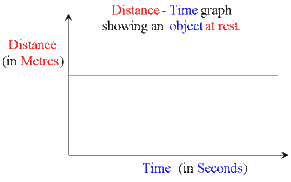
A distance-time graph is a graph that shows the relationship between distance traveled and the time taken.
PLOTTING the distance-time graph:
The Y axis should be the distance traveled from the start, meaning the bottom is time.
To plot simply mark the distance traveled at every chosen point of time: e.g every second.
The gradient of a distance-time graph is speed = distance / time , i.e S = D / T
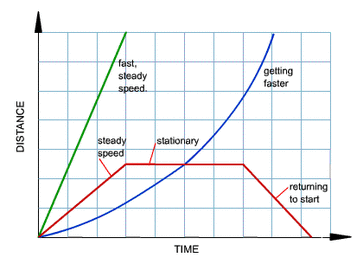
If it is curving upwards (blue line), the speed is increasing, if it is curving or sloping downwards, the speed is decreasing. So the gradient of the graph also tells us how the speed is changing. The steeper the line, the faster the object: it’s doing more distance for time- more up for across.