4. Scalar and Vector Quantities
Scalar Quantities:
Scalar quantities are those quantities which have a magnitude only.
Examples: mass , volume , distance , speed
Vector Quantities:
Vector quantities are those quantities which have magnitude as well as direction.
Examples: displacement, velocity, current, weight, force, acceleration
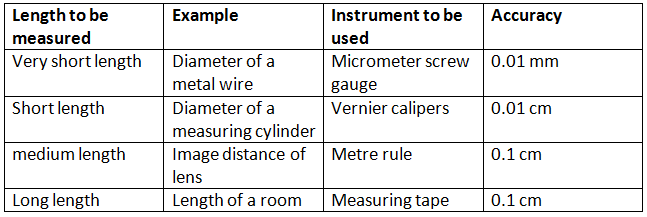
Measurement of length:
Verneir caliper:
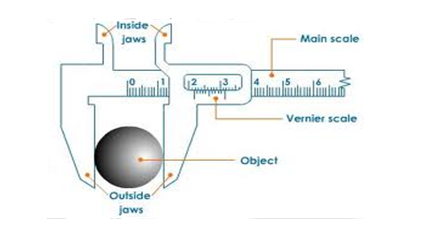
The following figure shows a vernier caliper, which consists of a main scale and a vernier scale.
How to read a vernier Caliper:
- Check zero error
- Place the object between the two jaws whose diameter is to be measured
- Place the object between the two jaws whose diameter is to be measured and close it until it is tight (not very tight, not very less).
- Read the main scale before the zero marking for the 1st place of decimal. ( )
- For the 2nd place of decimal, look at the vernier scale. Find a marking on the vernier scale that is in line with the main scale.
- The diameter is fund now by adding the main scale reading and the vernier scale reading
Inside jaws of vernier caliper….. Calculate internal diameter
Outside jaws of vernier caliper … Calculate external diameter
Zero Error In Vernier Caliper:
The error in the instrument which occurs when the zero of the main scale and vernier
Scale do not coincide when the jaws of the caliper coincide
Micrometer Screw Gauge:
How to read a Micro-Meter Screw Gauge:
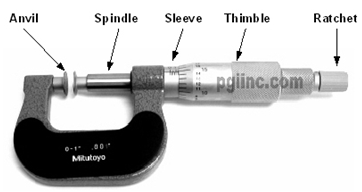
- Turn the thimble until the anvil and the spindle gently grip the object.
- Then turn the ratchet until it starts to click.
- Read the main scale releasing o the edge of the thimble/
- Now, look at the circular scale on the thimble. find a marking on the circular scale that is in line with the horizontal line of the main scale.
- Diameter is found by simply adding up the two decimal numbers.
Measurement of Time Using a Pendulum:
A simple pendulum consists of a bob and a string
The time taken for 1 compete oscillation of the bob is called the PERIOD (T) of the pendulum.
The number of complete oscillations made by the pendulum per second is called the frequency.
Period depends on:
- The length of the pendulum (increase with length).
- Acceleration due to gravity (decreases with increasing gravity).