
Heat and Temperature
Temperature:
It is the degree of hotness or coldness. As it refers to how hot or cold the object is .
Heat:
Heat refers to the amount of thermal energy that is being transferred from a hotter to a cooler region.
Constructing A Thermometric Scale:
- Choose a thermometric substance.
- Mercury or alcohol
- Select two fixed points.
- Ice point – as the upper fixed point.
- Steam point – as the lower fixed point.
- Divide the temperature range between the two fixed points into equal divisions.
Ice point (lower fixed point):
This is the temperature of pure melting ice at a pressure of one standard atmosphere. It is assigned a value of 0°C
Steam point (upper fixed point)
This is the temperature of steam from water boiling at a pressure of one standard atmosphere. It is assigned a value of 100 °C
Centigrade Scale:
A Temperature scale that defines the freezing points of water as 0 °Cand the boiling points of water as 100 °C
Determination Of Ice Point :
- Immerse the bulb of the thermometer into a funnel containing pure melting ice.
- The mercury level in the stem should be just above the ice.
Determination Of Steam Point:
Insert the thermometer into the apparatus. The bulb of the thermometer should be above the boiling water.
A manometer is used to ensure pressure inside the apparatus is the same as the atmospheric pressure outside.
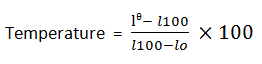
Measuring temperature using centigrade scale:
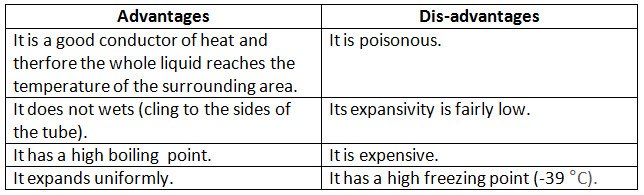
Advantages And Disadvantages Of Using Mercury As A Thermometric Liquid:
Advantages And Disadvantages Of Using Alcohol As A Thermometric Liquid:

Responsiveness:
This measures how quickly the thermometer can register changes in temperature.
Sensitivity:
This measure the amount of changes in the thermometric property (e.g. length of mercury column) per unit change in temperature.
Range:
This denotes the minimum and maximum temperature that the thermometer can measure.
Laboratory Thermometer:

Mercury is contained in a thin-walled glass bulb:
Thin wall of the glass bulb allows conduction of heat quickly through the glass(poor conductor) to the liquid.
The bulb is made small to contain a small amount of liquid:
A small amount of liquid responds more quickly to changes in temperature.
The bore of the capillary tube is fine and uniform:
The fine tube allows a noticeable movement of the liquid column for a small change in temperature. (good sensitivity).
Uniform tube ensures even expansion of liquid.
The walls of the long tube above the bulb are made thick:
This acts as a magnifying glass for easy reading of the mercury thread in the stem.
The size of the thermometer is relatively small:
The small size allows it to be portable and cheap to produce.
Clinical Thermometer:

The scale is limited to a small range of between 34 to 42:
Since the normal body temperature is 36.9 the short range allows for greater accuracy and the stem can be made responsibly short
Narrow constriction:
It prevents mercury from flowing back into the bulb by breaking the mercury thread at the constriction.
Thermocouple Thermometer:
It consists of two wires made of different metals such as iron and copper. The ends of the wires are joined together to form two junctions.
When two junctions are at different temperature e.g. one is hot and the other is cold. An emf is produced.
The greater the change in temperature the greater the emf is produced across the two junctions.
Advantages:
- Large temperature range (-200 to 1500 ).
- Very responsive to rapidly changing temperature due to its low thermal capacity, due to its small mass and metals are good conductors of heat.
- Output is the electrical signal, therefore, can be connected to a suitable electrical equipment for checking rapid or sudden temperature changes.
Transfer Of Thermal Energy
Thermal energy always flows from a region of higher concentration to a region of lower temperature.
Conduction:

Conduction is the process of thermal energy transfer without any flow of the material medium
Conduction occurs mostly from solid to solid due to molecular vibration.
- The particles at A absorbs heat energy and vibrate faster
- The particles collide with the neighboring particles and pass the heat energy to B
Metal is a good conductor of heat and plastic, rubber and glass are poor conductors of heat.
Why Are Metals Better Conductors?
Metals have free moving electrons. The electrons on the hot end gain energy and move faster as a result. These electrons than diffuse into the cooler end and when they collide with atoms on the cooler end they transfer energy.
Convection:

Convection Is the transfer of thermal energy by means of currents in a fluid (liquids or gases)
- Hot water rises, cold water sinks to set up conventional current.
- Hot water at the bottom gets heated and rises. Cold water is more dense sinks.
- The movement of the liquid due to a difference sets up a convection current.
- Hot air is less dense goes up cooler air being denser goes down
- The cooler surrounding air being denser sinks through the other end of the chimney to replace the less dense air.
Radiation:
Radiation is the continual emission of the infrared waves from the surface of all bodies transmitted without the aid of a medium. Example, transfer of thermal energy from the sun to earth.
Factors Affecting Rate of Infra-Red Radiation:
Color and texture of surface:
Dark/ black, dull and rough surfaces are better absorbers and emitters of infrared radiations than shiny/white and smooth surfaces.
Surface area:
The higher the temperature of the surface of the object relative to the surrounding temperature, the higher is the rate of infrared radiations.
Surface temperature:
In two objects with the same mass and material but different surface areas, the one with the larger surface area will emit and absorb infrared radiations at a higher rate.